
Graph representation
How a graph is stored decides what is cheap and what is expensive. This library offers both classic representations.
Adjacency list
AdjacencyList<TNode, TWeight> keeps one linked list of outgoing edges per node — internally a SortedList<TNode, LinkedList<Connection<TNode, TWeight>>>. Memory follows the edges that actually exist (O(V + E)), which makes it the right default for sparse graphs like road networks.
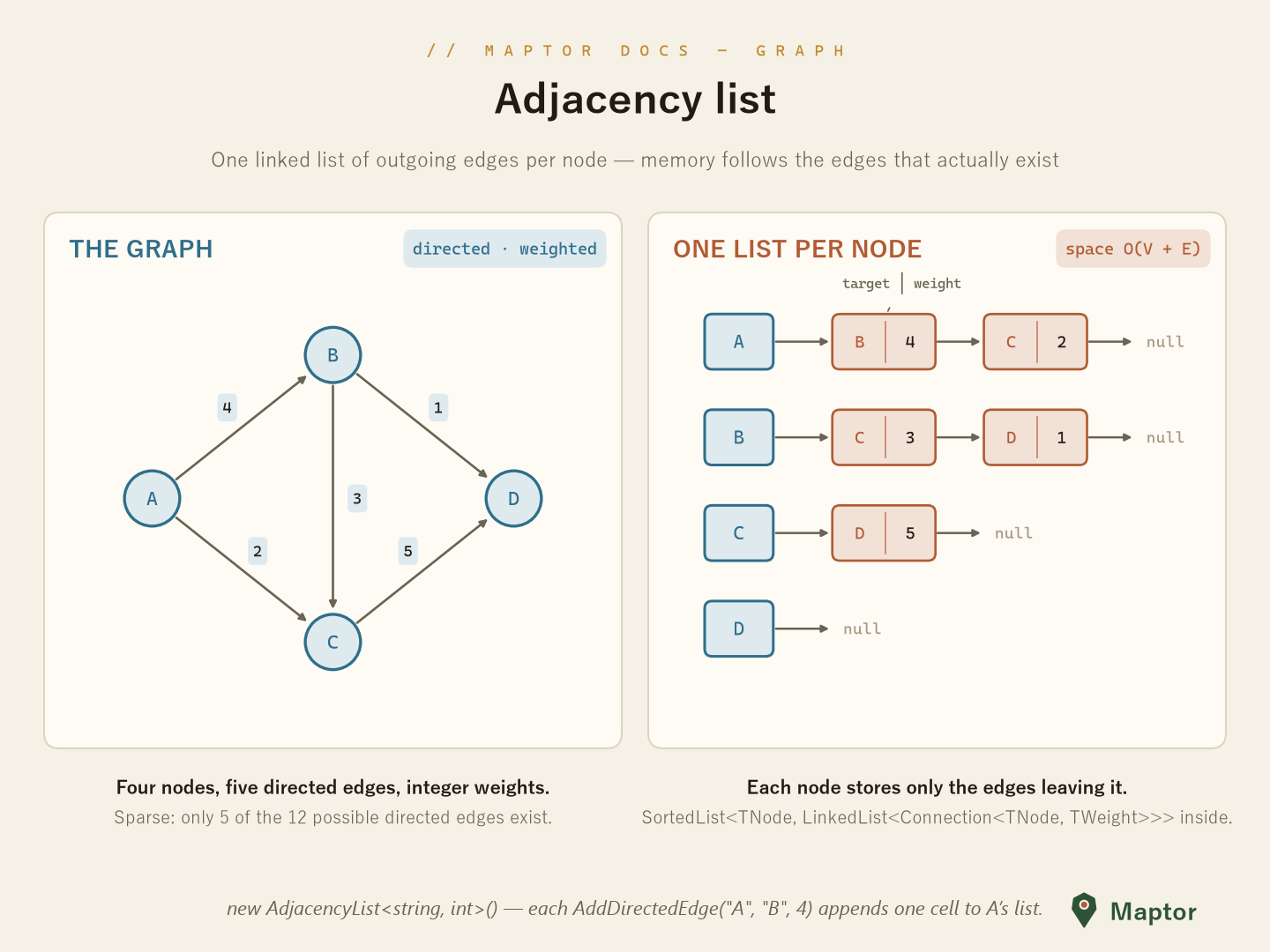
using IRI.Maptor.Core.Graph;

var g = new AdjacencyList<string, int>();
g.AddDirectedEdge("A", "B", 4);
g.AddDirectedEdge("A", "C", 2);
g.AddUndirectedEdge("B", "D", 1);      // adds both directions

var neighbors = g.GetConnections("A"); // A's outgoing (target | weight) cells
var reversed  = g.Transpose();         // every edge flipped — used by SCC
Adjacency matrix
The matrix form is a V × V weight table: row = source, column = target, ∞ for a missing edge. Any edge lookup is O(1), at the price of O(V²) space — best for small or dense graphs.
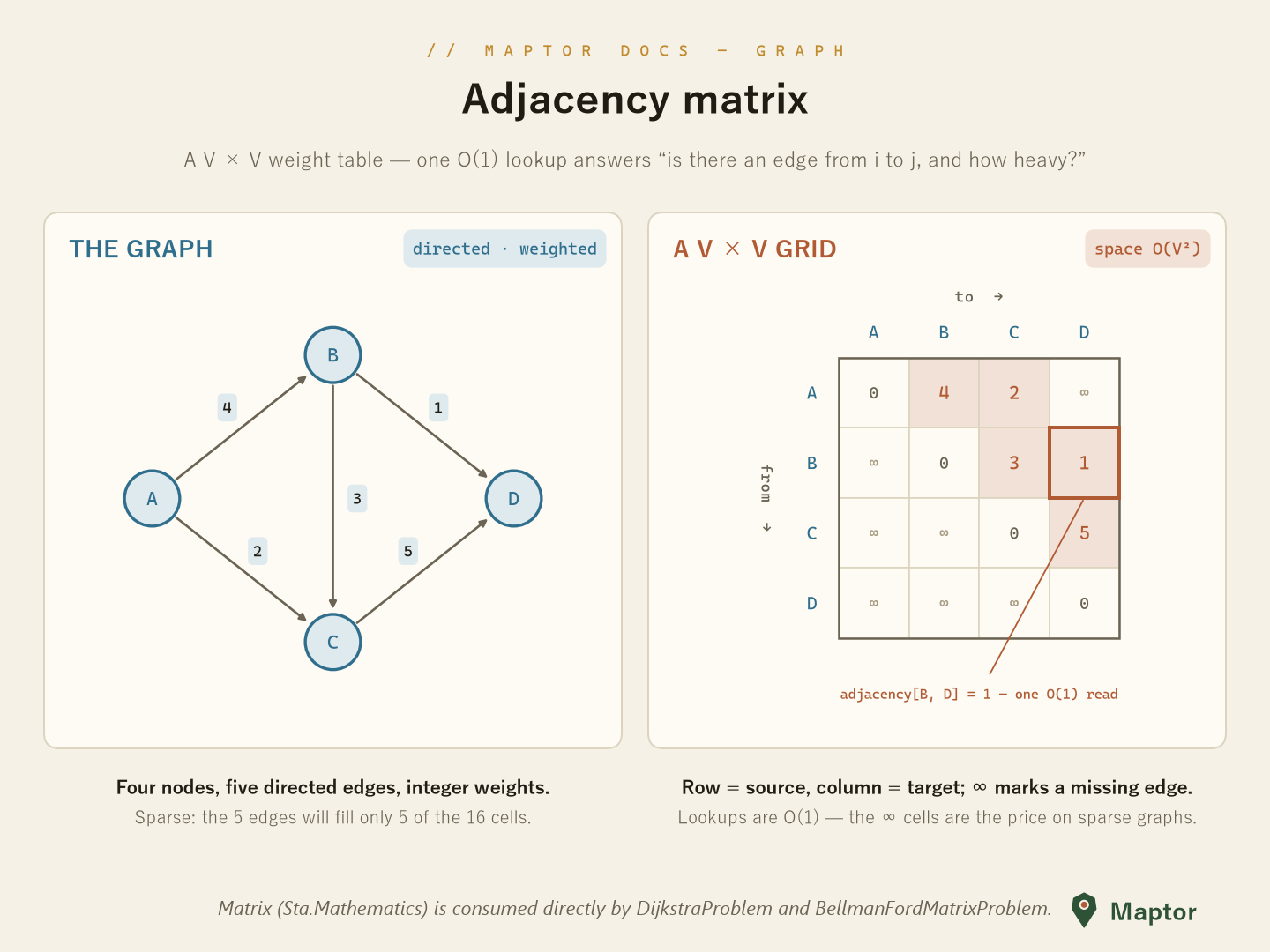
The matrix-based solvers (DijkstraProblem, BellmanFordMatrixProblem, FloydWarshallProblem) consume this form directly, and AdjacencyList has a constructor that converts a matrix into a list:
// nodes + TWeight[,] adjacencyMatrix → adjacency list
var fromMatrix = new AdjacencyList<string, double>(nodes, adjacencyMatrix);
Building blocks
Connection<TNode, TWeight>— a directed half-edge: target node + weight.Edge<TNode, TWeight>— a full edge: source node + itsConnection.DirectedAcyclicGraph<TNode, TWeight>— anAdjacencyListsubclass for DAGs.