
KMZ — Zipped KML
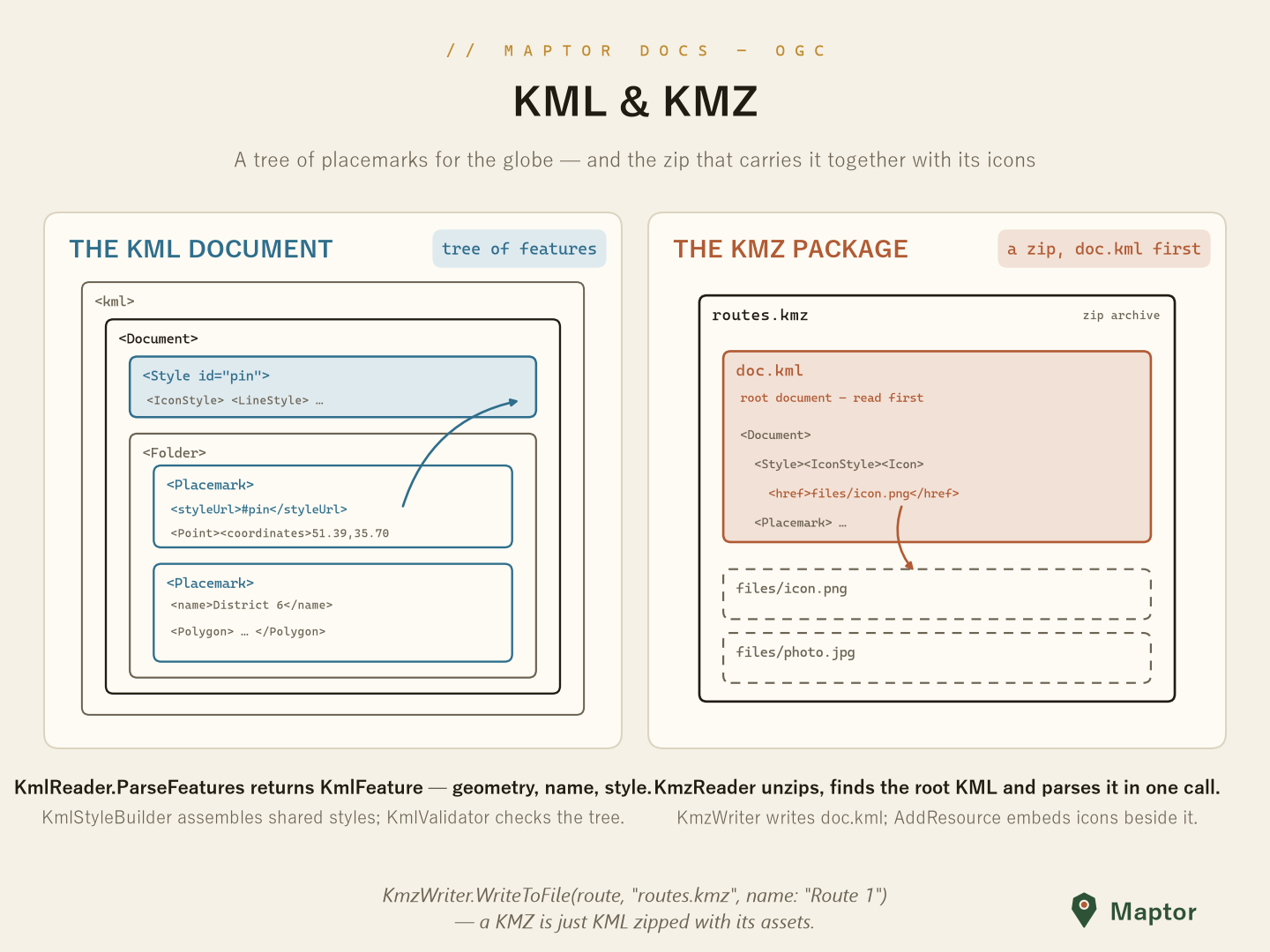
A KMZ is a ZIP archive whose root document (doc.kml) travels together with the icons and images it references. The readers and writers here (namespace IRI.Maptor.Core.Ogc.Kml) build on KmlReader / KmlWriter, so everything KML supports — features, styles, folders — works inside a KMZ too.
Reading
KmzReader unzips, finds the root KML (preferring doc.kml) and parses it in one call. Embedded assets are listed and extracted separately.
using IRI.Maptor.Core.Ogc.Kml;

var geometries = KmzReader.ReadFromFile("map.kmz", targetSrid: 4326);   // List<IGeometry>
var features   = KmzReader.ReadFeaturesFromFile("map.kmz");             // List<KmlFeature>

var resources = KmzReader.GetResourceFiles("map.kmz");                  // ["images/icon.png", …]
byte[]? icon  = KmzReader.ExtractResource("map.kmz", "images/icon.png");
KmzReader.Parse(stream) reads from any stream, and every file method has an Async twin.
Writing
KmzWriter writes the geometry (or features) as doc.kml inside the archive; AddResource embeds assets afterwards, under the relative path the KML's <href> elements use.
KmzWriter.WriteToFile(geometry, "london.kmz", name: "London", description: "Capital of England");

KmzWriter.AddResourceFromFile("london.kmz", "images/icon.png", @"C:\assets\icon.png");
// in the KML: <href>images/icon.png</href> — always forward slashes, always relative
Extension methods in IRI.Maptor.Extensions shorten the common case: geometry.SaveAsKmz("london.kmz", "London") (plus SaveAsKmzAsync, and overloads for geometry lists and KmlFeature lists).
For document structure, styling and validation, see ../KML/README.md.