
R-trees
Where a k-d tree indexes points by cutting space, an R-tree indexes extents by grouping them: nearby rectangles get wrapped in a parent box, parents get wrapped in grandparents, and a query that misses a box can drop everything inside it.
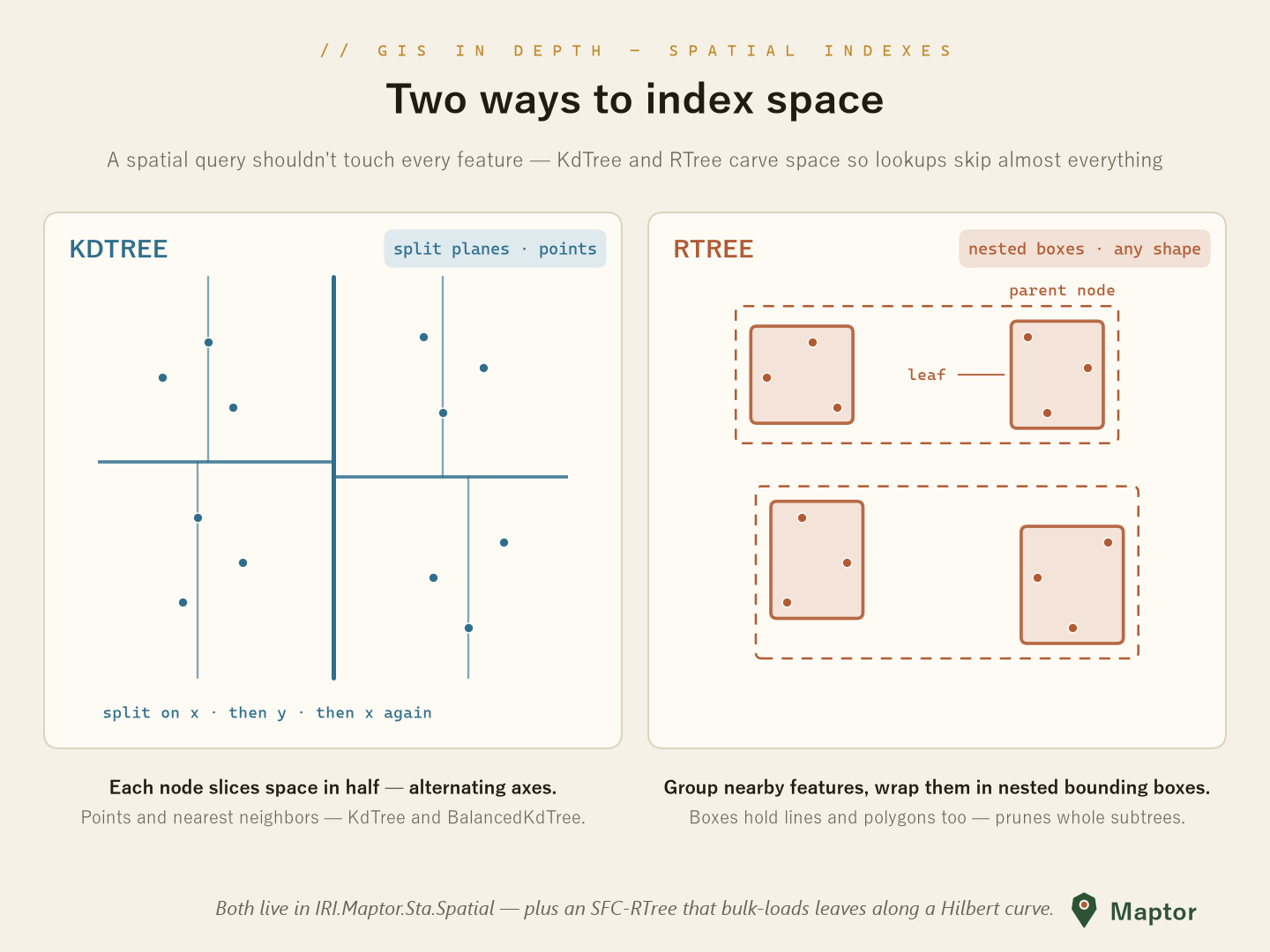
That difference matters because most map data is not points. Roads, parcels and rivers have area, and a k-d tree has nowhere to put them — an R-tree stores each feature's bounding box, so lines and polygons index as naturally as points do.
Rectangle — the key type
Everything in this folder is keyed by Rectangle, a plain struct of minX, minY, maxX, maxY:
using IRI.Maptor.Core.Spatial.AdvancedStructures;

var parcel = new Rectangle(minX: 51.30, minY: 35.68, maxX: 51.36, maxY: 35.72);

double area      = parcel.GetArea();
double perimeter = parcel.GetPerimeter;
var    center    = (parcel.CenterX, parcel.CenterY);

// union of two boxes — how a parent node grows to hold a child
var merged = parcel + new Rectangle(51.34, 35.70, 51.40, 35.75);

// the cost function behind every insertion: how much would this box have to grow?
double growth = parcel.GetEnlargementArea(newFeature);
RTree — least-enlargement insertion
RTree is the classic B-tree-shaped index. A new key descends into whichever child would have to grow the least to contain it, and nodes split when they overflow 2 × minimumDegree - 1 keys.
using IRI.Maptor.Core.Spatial.AdvancedStructures;

var boxes = new[]
{
    new Rectangle(51.30, 35.68, 51.36, 35.72),
    new Rectangle(51.34, 35.70, 51.40, 35.75),
    new Rectangle(51.44, 35.60, 51.49, 35.64),
    new Rectangle(51.46, 35.62, 51.52, 35.67),
};

var tree = new RTree(boxes, minimumDegree: 2);   // must be >= 2

tree.Insert(new Rectangle(51.31, 35.69, 51.33, 35.71));

var root = tree.Root;                 // RTreeNode: Boundary, IsLeaf, NumberOfKeys
You can supply your own descent rule instead of least-enlargement — the comparer returns the index of the child to descend into:
// the built-in rule, passed explicitly
var tree = new RTree(new RTreeNode(), RTree.FindTheBestRectangle, minimumDegree: 4);
SFCRTree — bulk-loading along a space-filling curve
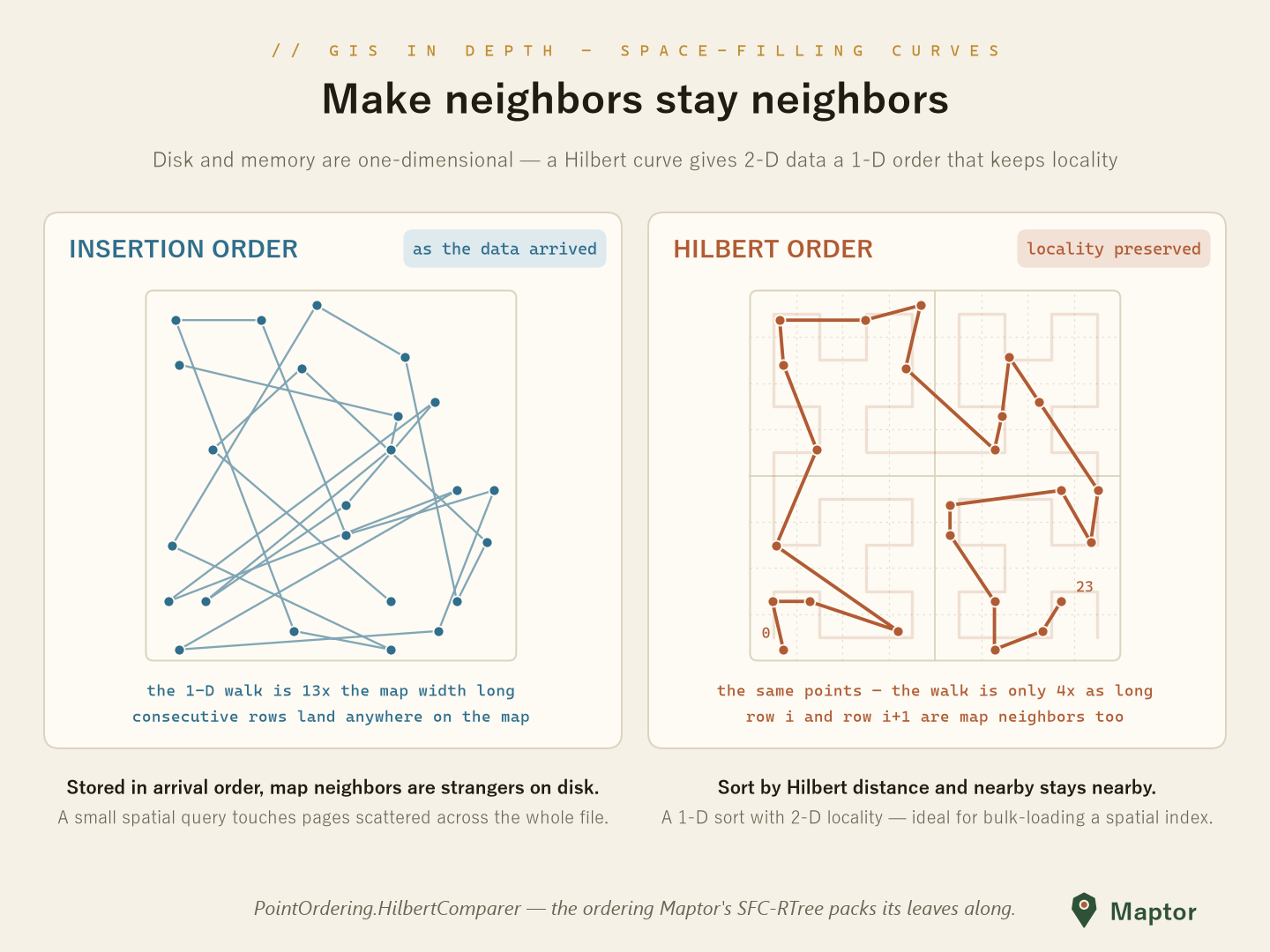
SFCRTree builds the same nested-box structure, but instead of choosing by area growth it keeps keys in space-filling-curve order. Sorting 2-D boxes by their position along a Hilbert curve gives a 1-D sequence in which map neighbours stay sequence neighbours, so leaves fill with features that are genuinely near each other — and on disk, a small map query touches a few consecutive pages instead of scattered ones.
using IRI.Maptor.Core.Spatial.AdvancedStructures;

// the comparer is required — there is no parameterless Hilbert overload
var tree = new SFCRTree(boxes, SFCRTree.HilbertComparer, minimumDegree: 4);

var extent = tree.Boundary;    // grows as keys arrive; the curve is fitted to it
Each comparer ranks a rectangle by its centre point along a different curve. Hilbert has the best locality and is the sensible default; the rest are there because the curves themselves are comparable:
| Comparer | Curve |
|---|---|
SFCRTree.HilbertComparer |
Hilbert — best locality preservation |
SFCRTree.ZOrderingComparer |
Z-order (Morton) — cheapest to compute |
SFCRTree.GrayComparer |
Gray-code ordering |
SFCRTree.NOrderingComparer |
N-ordering |
SFCRTree.PeanoComparer, Peano02Comparer, Peano03Comparer |
Peano, Wunderlich, Peano-meander |
SFCRTree.DiagonalLebesgueComparer, UOrderOrLebesgueSquareComparer |
Lebesgue variants |
The curves come from Analysis/SFC, where they are generated from higher-order functions rather than hard-coded.
Status
Both R-tree types are early-stage: insertion paths are marked untested in source, and neither exposes a range or nearest-neighbour query yet — they build the structure, and you traverse from Root yourself. For point queries today, use BalancedKdTree, which has both queries implemented and tested.
Files
Rectangle.cs — the key struct. RTree.cs, RTreeNode.cs — the tree and its nodes. SFCRTree.cs — the space-filling-curve variant. All in namespace IRI.Maptor.Core.Spatial.AdvancedStructures.
Reference
The curve orderings SFCRTree packs its leaves along, and how they are generated and compared:
Narimani Rad, H., & Karimipour, F. (2021). Representation and generation of space-filling curves: a higher-order functional approach. Journal of Spatial Science, 66(3), 459–479. doi:10.1080/14498596.2019.1668870
NuGet: IRI.Maptor.Core.Spatial
Issues: GitHub Issues