
این صفحه هنوز ترجمه نشده است؛ نسخهٔ انگلیسی نمایش داده میشود.
KML — Keyhole Markup Language
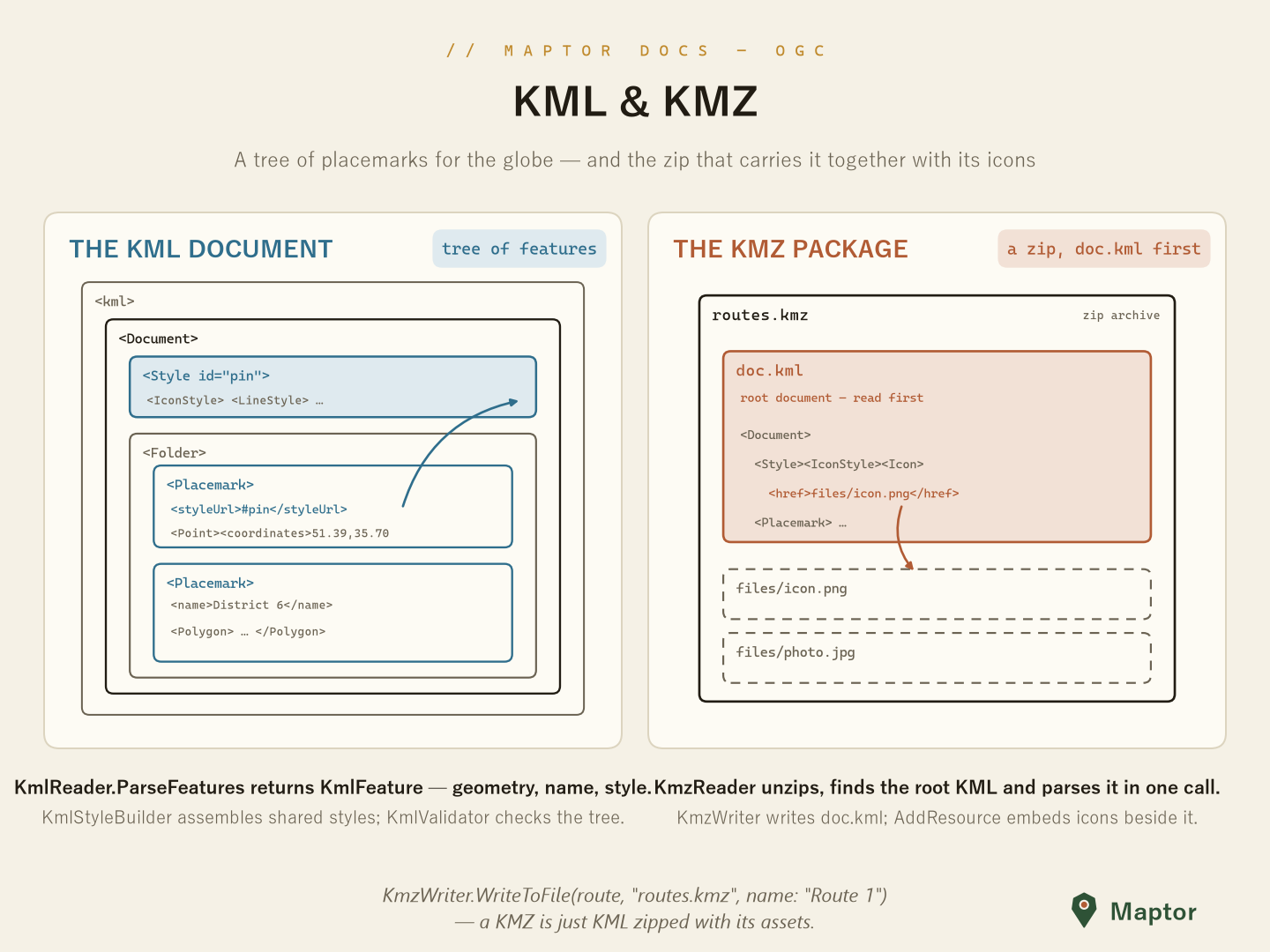
OGC KML 2.2: a tree of placemarks, folders and shared styles for the globe. All classes live in the IRI.Maptor.Core.Ogc.Kml namespace (not Core.Ogc.KML), and KML's convention is WGS84 (SRID 4326) throughout.
Reading
KmlReader offers two levels: geometry-only, or full-fidelity KmlFeature objects that keep the name, description, attributes, style and region metadata.
using IRI.Maptor.Core.Ogc.Kml;

var geometries = KmlReader.ReadFromFile("map.kml", targetSrid: 4326);   // List<IGeometry>

var features = KmlReader.ReadFeaturesFromFile("map.kml");               // List<KmlFeature>
foreach (var f in features)
    Console.WriteLine($"{f.Name}: {f.Geometry.Type}, {f.Attributes.Count} attributes");
KmlReader.Parse(kmlString) / ParseFeatures(kmlString) do the same from a string in memory.
Writing
KmlWriter turns geometries or features into KML; ToKmlWithFolders groups them into <Folder> elements.
string kml = KmlWriter.ToKml(geometry, name: "London", description: "Capital of England");
// <kml><Document><Placemark>…

var folders = new Dictionary<string, List<Geometry<Point>>>
    { ["Cities"] = cities, ["Rivers"] = rivers };
string grouped = KmlWriter.ToKmlWithFolders(folders, "Geographic Data");

await KmlWriter.WriteToFileAsync(geometry, "london.kml", "London");
If the data isn't in WGS84, pass a projectToGeodeticFunc to reproject on the way out.
Styling
KmlStyleBuilder assembles a StyleType fluently; give it an id and reference it from placemarks as a shared style. KmlDecorator applies styles and <ExtendedData> to existing placemarks.
var pinStyle = new KmlStyleBuilder()
    .WithId("pin")
    .WithIconStyle(iconHref: "http://.../red-pushpin.png", scale: 1.2)
    .WithLabelStyle(red: 255, green: 0, blue: 0, scale: 1.1)
    .Build();
// colors are KML aabbggrr — KmlStyleBuilder.CreateKmlColorFromHex("#80FF0000") handles the flip
Validation
KmlValidator checks a document against the KML 2.2 rules — with the OGC schemas embedded in the assembly, so schema validation works offline and reports line/column context.
bool ok = KmlValidator.Validate(kmlContent, out var errors, out var warnings);

var options = new KmlValidator.KmlValidationOptions { ValidateSchema = true };
bool schemaOk = KmlValidator.Validate(kmlContent, out errors, out warnings, options);

string report = KmlValidator.GenerateValidationReport(kmlContent);
Generated schema models
The strongly typed KML 2.2 models under Generated/ (IRI.Maptor.Core.Ogc.Kml.Primitives, .Atom, .Xal, .Gx) are produced with XmlSchemaClassGenerator from tools\schema\kml22.local.xsd; the validator consumes the compiled schemas embedded from Schemas/. Full API inventory and implementation notes: KML_IMPLEMENTATION_SUMMARY.md.
For KML packed in a zip with its icons and images, see ../KMZ/README.md.