
این صفحه هنوز ترجمه نشده است؛ نسخهٔ انگلیسی نمایش داده میشود.
K-d trees
A k-d tree slices space in half at every node — x at even levels, y at odd — so a query walks down to the region it cares about and never looks at the rest of the map.
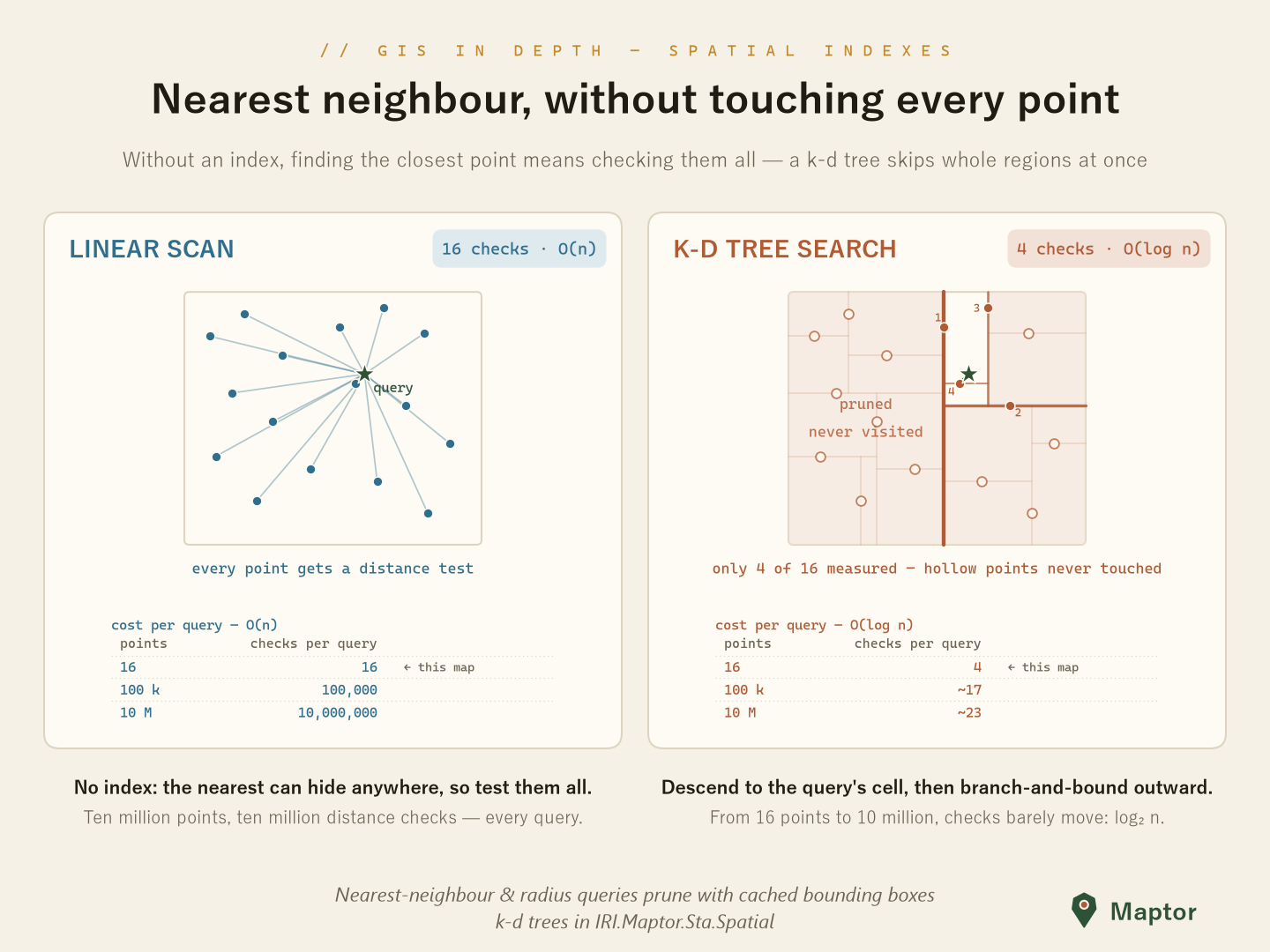
Finding the closest of 16 points costs 16 distance tests without an index and 4 with one. The gap widens with scale: 10 million points still cost ~23 checks, because each level halves what is left to search.
The two classes
KdTree<T> |
BalancedKdTree<T> |
|
|---|---|---|
| Balancing | none — shape follows insertion order | red-black rotations on every insert |
| Node boxes | no | every node caches its subtree's MinimumBoundingBox |
| Queries | none — structure only | FindNearestNeighbour, FindNeighbours |
| Use it for | teaching, tiny static sets | everything else |
Both queries are verified against a brute-force scan in the test suite.
KdTree — the plain form
KdTree<T> cycles through the comparers you supply, one per level, and hangs each new point wherever it falls off the tree. Nothing rebalances.
using IRI.Maptor.Core.Common.Primitives;
using IRI.Maptor.Core.Spatial.AdvancedStructures;

var points = new[]
{
    new Point(51.33, 35.70), new Point(51.42, 35.75),
    new Point(51.38, 35.68), new Point(51.45, 35.72),
};

var comparers = new List<Func<Point, Point, int>>
{
    (p1, p2) => p1.X.CompareTo(p2.X),   // even levels split on x
    (p1, p2) => p1.Y.CompareTo(p2.Y),   // odd levels split on y
};

var tree = new KdTree<Point>(points, comparers);

var root = tree.Root;                    // walk it yourself: Point, LeftChild, RightChild
The class exposes the structure and nothing else — no search methods. Reach for it when you want to inspect how splitting works; use BalancedKdTree<T> in production.
BalancedKdTree — the production form
Same splitting idea, plus red-black balancing and cached bounding boxes. It answers the two classic spatial questions:
using IRI.Maptor.Core.Common.Primitives;
using IRI.Maptor.Core.Spatial.AdvancedStructures;

var tree = new BalancedKdTree<Point>(points, comparers, Point.NaN, p => p);

// closest feature to a click
var nearest = tree.FindNearestNeighbour(new Point(51.40, 35.71));

// everything inside a tolerance radius
var withinRange = tree.FindNeighbours(new Point(51.40, 35.71), distance: 0.05);

// add more points later — the tree rebalances itself
tree.Insert(new Point(51.36, 35.69));

var all = tree.GetAllValues();
The last two constructor arguments are worth a word. nilValue is the sentinel the tree hands to its leaf terminator (Point.NaN for points), and pointFunc tells the tree how to read coordinates out of T — pass p => p when T is already an IPoint, or a selector when it is your own type:
// index your own records, not bare points
var tree = new BalancedKdTree<Station>(stations, stationComparers,
                                       nilValue: Station.Empty,
                                       pointFunc: s => s.Location);
Both queries take an optional distance function. The default is Euclidean; swap in an ellipsoidal one when the coordinates are geographic:
using IRI.Maptor.Core.Spatial.Analysis;

var nearest = tree.FindNearestNeighbour(
    new Point(51.40, 35.71),
    (p1, p2) => SpatialUtility.GetEllipsoidalLength(p1, p2));
Insertion order is the catch
A k-d tree is only fast while it stays shallow, and the plain insertion algorithm makes no such promise. Feed it points that are already sorted — a GPS track, road vertices, scanline output — and every comparison sends the new point the same way, so the tree degenerates into a linked list.
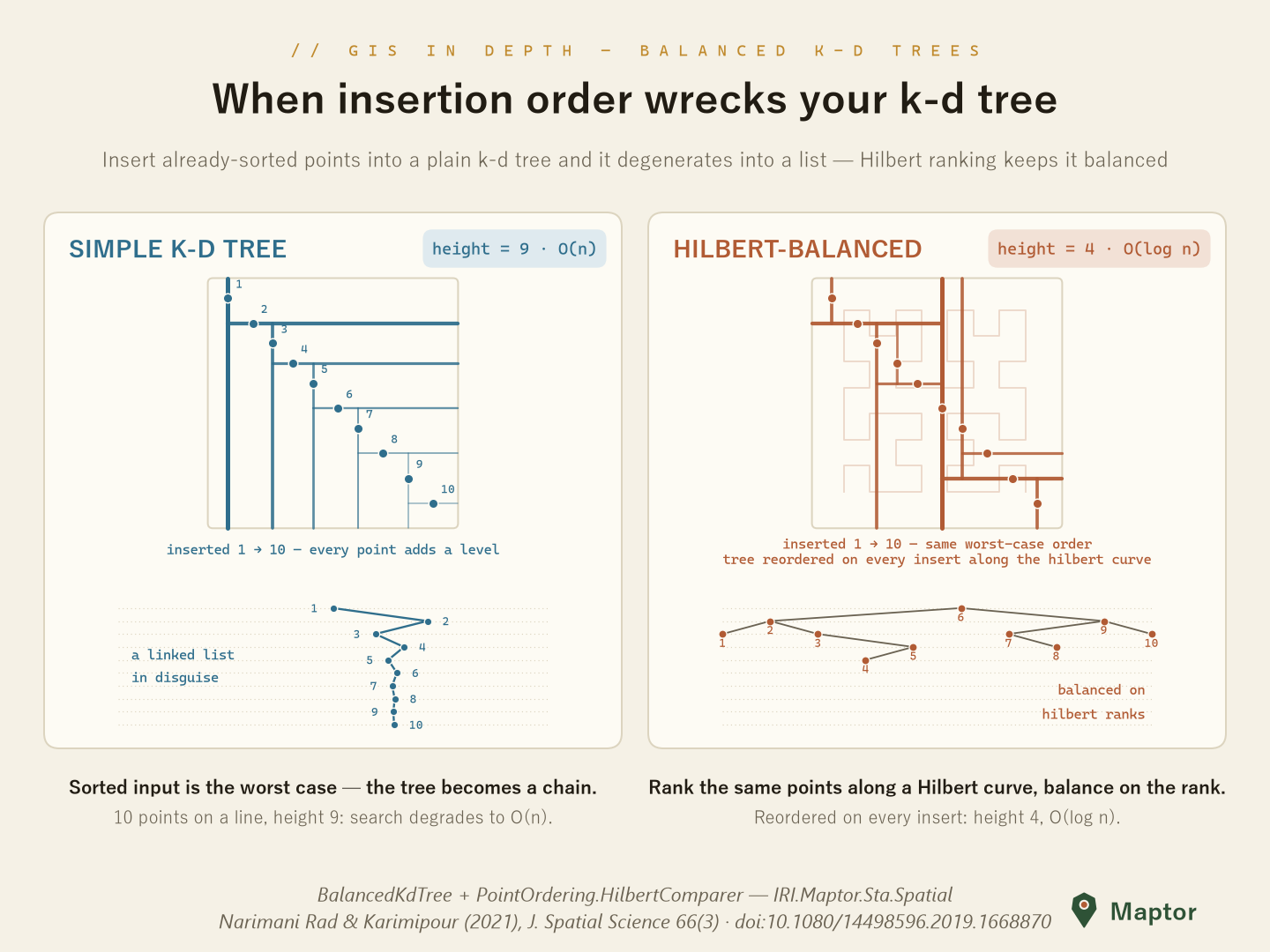
Ten points on a line give a plain tree of height 9. Ranking the same points along a Hilbert curve and balancing on that rank gives height 4:
using IRI.Maptor.Core.Spatial.Analysis.SFC;

// one comparer: the point's position along a Hilbert curve over the data extent
var boundary = PointOrdering.GetBoundary(points, 0.5);

var hilbertComparer = new List<Func<Point, Point, int>>
{
    (p1, p2) => PointOrdering.HilbertComparer(p1, p2, boundary)
};

var balanced = new BalancedKdTree<Point>(points, hilbertComparer, Point.NaN, p => p);
Full story, with the numbers and the theory: Hilbert-balanced k-d tree — when insertion order matters.
One comparer or two
The two forms above are not interchangeable, and the difference is worth understanding before you pick one.
BalancedKdTree<T> chooses a node's comparer from that node's depth — comparers[level % comparers.Count] — but a red-black rotation moves nodes between depths. A node inserted at depth 1 under "compare on y", whose subtree was partitioned by y, can end up at depth 0 where the tree now says "compare on x". So with more than one comparer the k-d ordering invariant does not survive balancing:
- Queries stay correct.
FindNearestNeighbourandFindNeighboursprune on each node's cachedMinimumBoundingBoxand never consult the comparers at all. Both are checked against a brute-force scan in the test suite, with x/y comparers. - Pruning gets weaker. Points land in whichever subtree the mismatched comparison sends them, so the cached boxes overlap more than they need to and a query rules out fewer subtrees.
With a single total-order comparer — the Hilbert rank — level % 1 is always 0, every node uses the same key, and the structure is an ordinary 1-D search tree where rotations are exactly valid. That is the form to reach for when the index has to stay fast:
| x/y comparers | single Hilbert comparer | |
|---|---|---|
| Balance | kept — rotations are structural | kept |
| Ordering invariant | not maintained after rotations | exact |
| Query results | correct | correct |
| Box tightness | degrades as the tree is rotated | holds, and Hilbert locality keeps boxes small |
Files
KdTree.cs, KdTreeNode.cs — the plain tree. BalancedKdTree.cs, BalancedKdTreeNode.cs — the balanced one. All four live in namespace IRI.Maptor.Core.Spatial.AdvancedStructures.
Reference
The Hilbert ordering used for balancing, and the higher-order construction of the curves behind it:
Narimani Rad, H., & Karimipour, F. (2021). Representation and generation of space-filling curves: a higher-order functional approach. Journal of Spatial Science, 66(3), 459–479. doi:10.1080/14498596.2019.1668870
NuGet: IRI.Maptor.Core.Spatial
Issues: GitHub Issues