
Advanced structures
Spatial indexes and point clustering: a spatial query shouldn't touch every feature — these structures carve space so lookups skip almost everything.
| Folder | Structures | Index what | Status |
|---|---|---|---|
| KdTrees | KdTree<T>, BalancedKdTree<T> |
points | production — both queries verified against a brute-force scan |
| RTrees | RTree, SFCRTree |
bounding boxes — lines, polygons, anything with extent | early-stage — builds the index, no queries yet |
| GeoStatistics | PointClusters<T>, KdTreePointClusters<T> |
groups of points | production |
K-d trees →
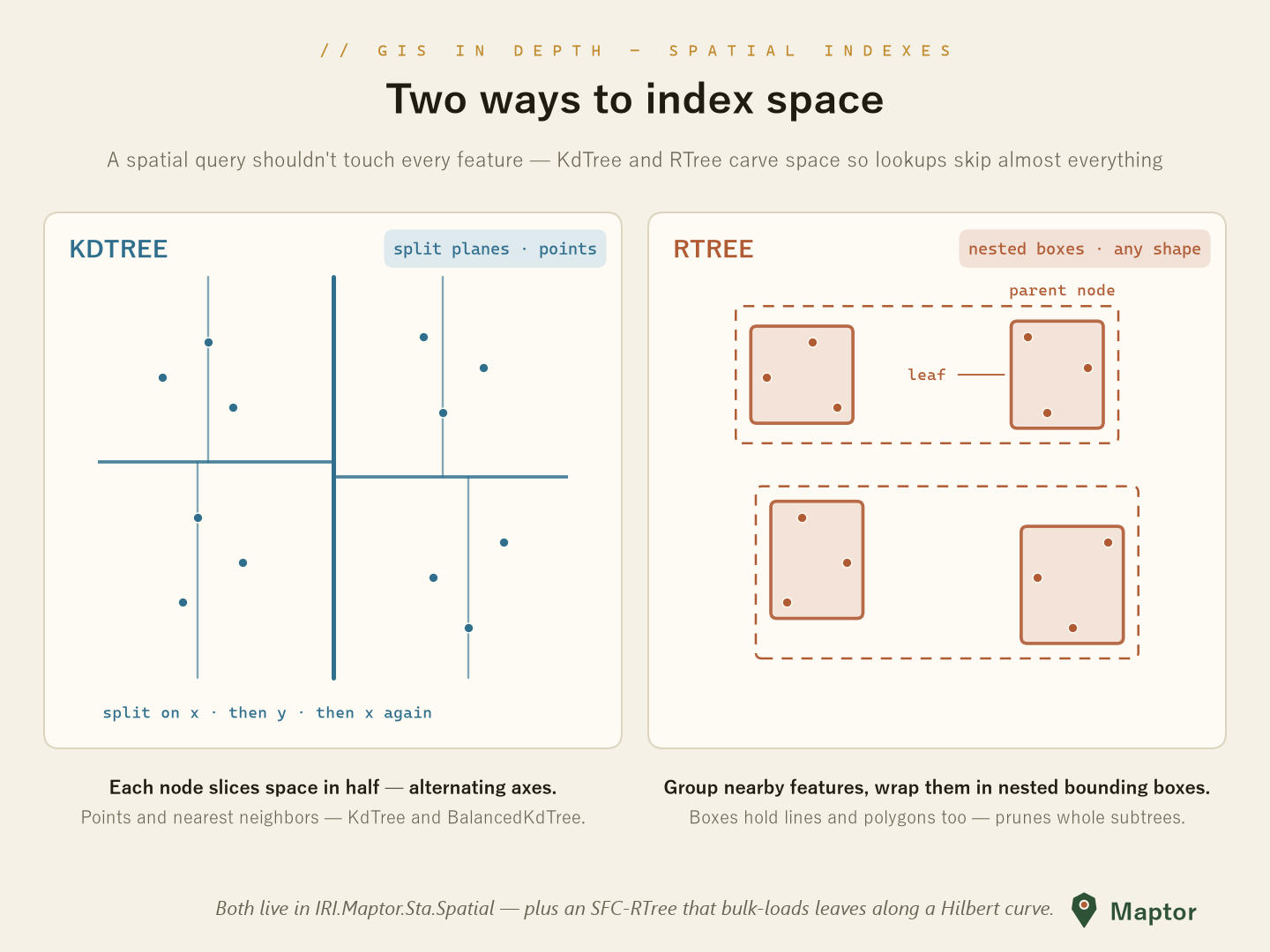
Split space in half at every node, alternating axes. BalancedKdTree<T> is the one to reach for: red-black balancing keeps it shallow under any insertion order, every node caches its subtree's bounding box, and it answers both classic queries.
using IRI.Maptor.Core.Common.Primitives;
using IRI.Maptor.Core.Spatial.AdvancedStructures;

var comparers = new List<Func<Point, Point, int>>
{
    (p1, p2) => p1.X.CompareTo(p2.X),   // even levels split on x
    (p1, p2) => p1.Y.CompareTo(p2.Y),   // odd levels split on y
};

var tree = new BalancedKdTree<Point>(points, comparers, Point.NaN, p => p);

var nearest              = tree.FindNearestNeighbour(new Point(51.4, 35.7));
var withinToleranceRange = tree.FindNeighbours(new Point(51.4, 35.7), distance: 0.05);
Insertion order is the catch — sorted input degenerates a plain k-d tree into a linked list. Ranking points along a Hilbert curve fixes it: Hilbert-balanced k-d tree.
R-trees →
Group nearby Rectangles into nested bounding boxes, B-tree style, so a query can discard whole subtrees at once — and, unlike a k-d tree, index features that have extent rather than just points.
using IRI.Maptor.Core.Spatial.AdvancedStructures;

var tree = new RTree(boxes, minimumDegree: 2);           // least-enlargement descent

// or pack leaves in space-filling-curve order, so map neighbours stay disk neighbours
var packed = new SFCRTree(boxes, SFCRTree.HilbertComparer, minimumDegree: 4);
GeoStatistics — point clustering
PointClusters<T> greedily groups points by any membership rule you supply; KdTreePointClusters<T> runs the same idea on top of a BalancedKdTree so each membership test only probes nearby candidates. The one-shot helper covers the common case — cluster by radius and keep one representative per group:
using IRI.Maptor.Core.Spatial.AdvancedStructures;

// thin out a dense point set: one center per 0.01°-radius cluster
var centers = KdTreePointClusters<Point>.GetClusterCenters(points, Point.NaN, radius: 0.01);
GetClusterCentersbuilds onBalancedKdTree.FindNeighbours, so every point withinradiusof a chosen center is absorbed into that center's cluster.
Reference
Space-filling curves underpin both the balanced k-d tree's ordering and SFCRTree's leaf packing:
Narimani Rad, H., & Karimipour, F. (2021). Representation and generation of space-filling curves: a higher-order functional approach. Journal of Spatial Science, 66(3), 459–479. doi:10.1080/14498596.2019.1668870
NuGet: IRI.Maptor.Core.Spatial
Issues: GitHub Issues